
Finding small, dark specks in a kitchen drawer, along a baseboard, or at the back of a pantry is often the first hard evidence that mice have moved in. Mouse droppings, also called mouse poop, are one of the clearest signs of an active rodent problem, and they deserve attention for a second reason: handled the wrong way, they can pose a real health risk.
This guide covers what mouse droppings look like, how to tell them apart from rat droppings and other look-alikes, why they can be dangerous, and how to clean them up safely. That last point carries extra weight in Colorado, where deer mice are common in many homes and can spread illness through their droppings.
Here is how to identify mouse droppings, what health risks they carry, and the safe way to clean them up, whether you are dealing with a few specks or a larger mess.
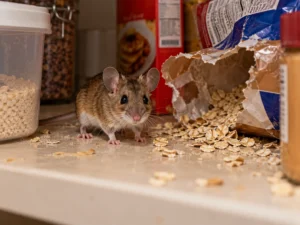
What Do Mouse Droppings Look Like?
Mouse droppings are small, usually about 1/8 to 1/4 inch long (roughly 3 to 6 millimeters), and shaped like dark grains of rice with pointed, tapered ends. Fresh droppings are dark brown to black, soft, and slightly shiny. Because mice leave droppings as they move rather than in one spot, you tend to find them scattered across an area instead of piled together.
A single mouse can produce as many as 50 to 75 droppings in a day. That is why even one mouse leaves behind a surprising amount of evidence, and why a scattering of droppings across a drawer or a shelf usually points to regular, ongoing activity rather than a one-time visitor.
Mouse Droppings vs. Rat Droppings and Other Look-Alikes
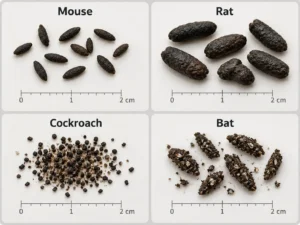
Identifying the source correctly matters, because the response is different for each pest. A quick comparison:
- Rat droppings: much larger, around 1/2 to 3/4 inch, thicker, and with blunter ends. If the droppings look notably big, you are likely dealing with rats rather than mice.
- Cockroach droppings: tiny, blunt, and ridged, closer in appearance to coffee grounds or coarse black pepper.
- Bat guano: similar in size to mouse droppings but typically found in attics, and it crumbles into shiny specks (bits of digested insects) rather than staying firm.
If you are not certain what you are looking at, a professional inspection can confirm the species and, just as important, find where it is getting in.
Where You Will Find Mouse Droppings
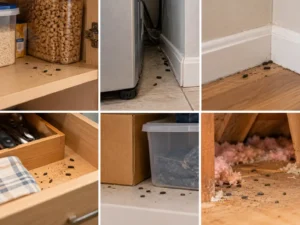
Mice stay close to food and shelter and travel the same routes night after night, so droppings tend to cluster in predictable places:
- Inside kitchen drawers, cabinets, and pantries
- Behind and underneath appliances like the refrigerator and stove
- Along baseboards and in the corners where walls meet the floor
- In closets, storage boxes, and rarely used drawers
- In attics, basements, crawl spaces, and inside wall voids
Droppings are one of several signs worth recognizing early. Blue Tick’s guide to the early signs of a mouse infestation walks through the full list. If you are finding them along walls or hearing activity behind them, our guide to mice in walls explains what that usually means.
Are Mouse Droppings Dangerous?
Yes, they can be, which is exactly why they should never be swept or vacuumed up while dry. Disturbing droppings, urine, or nesting material can send contaminated particles into the air, where they can be breathed in. The main concerns are:
- Hantavirus. In the western United States, including Colorado, deer mice are the primary carriers of hantavirus, which can cause a rare but serious respiratory illness. This is a particular concern in foothill, rural, and mountain homes, where deer mice are more common than the urban house mouse.
- Salmonella. Mice can contaminate food and surfaces with bacteria that cause food poisoning.
- Allergies and asthma. Dried droppings and urine can trigger allergic reactions and aggravate asthma, especially in enclosed spaces.
The risk is very manageable with the right precautions. It is simply the reason that careful cleanup, rather than a quick sweep, is so important.
How to Clean Up Mouse Droppings Safely
The goal is to clean without stirring particles into the air. A safe method looks like this:
- Ventilate first. Open windows and doors and let the space air out for about 30 minutes before you begin, and step out of the room while it does.
- Protect yourself. Put on disposable gloves, and for larger cleanups, add a well-fitting mask.
- Do not sweep or vacuum. Both can push particles into the air. This is the single most important rule.
- Dampen before wiping. Spray the droppings and the surrounding area with a disinfectant or a bleach solution (about one part bleach to ten parts water) and let it soak for five minutes.
- Wipe and bag. Use paper towels to pick everything up, seal it in a plastic bag, then place that inside a second bag before disposing of it.
- Disinfect the area. Wipe down nearby surfaces, countertops, and floors with disinfectant.
- Wash up. Remove your gloves and wash your hands thoroughly.
For a large infestation, heavy contamination, or droppings in an enclosed space like an attic or crawl space, professional sanitation and cleanup is the safer route, particularly where deer mice may be involved.
Fresh or Old? What the Droppings Tell You
The condition of droppings tells you whether the problem is active right now. Fresh droppings are dark, soft, and shiny. Older ones fade to gray, dry out, harden, and crumble when pressed. Finding fresh, dark droppings means mice are active currently, not that you are looking at an old problem. Either way, the presence of droppings does not mean the mice have moved on.
What Droppings Mean for Your Home
Droppings are rarely a one-time event. Because mice breed quickly and leave so much evidence each day, finding them usually means at least one active mouse, and often several. Cleaning up the droppings handles the mess, not the cause. Actually solving the problem means removing the mice and sealing the entry points they used to get inside, which is where professional mice and rodent control comes in.
Frequently Asked Questions About Mouse Droppings
Are mouse droppings dangerous to pets?
They can be. A dog or cat that eats droppings, or catches and eats a mouse, can pick up intestinal parasites or bacteria such as salmonella, and a mouse that has swallowed rodenticide elsewhere poses a secondary poisoning risk. Hantavirus is mainly a concern for people rather than pets, but it is still wise to keep animals away from droppings and nesting material and to clean the area promptly. If your pet eats droppings or a mouse and seems unwell, contact your veterinarian.
Can you get sick from breathing in mouse droppings?
It is possible, which is why dry droppings should never be swept or vacuumed. Disturbing them can release particles into the air. In Colorado, deer mice can carry hantavirus, so careful cleanup, or professional help for larger jobs, is the safe approach.
Do mouse droppings attract more mice?
They can contribute to it. Mouse droppings and urine carry scent that signals a safe, established area to other mice, so leaving them in place can make a space more inviting rather than less. Thorough cleanup removes those scent cues, which is one more reason to clean droppings promptly and seal the openings that let mice in.
Do mouse droppings have a smell?
Mouse droppings and urine give off a musty, ammonia-like odor, especially when activity is concentrated in an enclosed space. A strong smell often points to a larger or longer-running problem.
When to Call Blue Tick Pest & Wildlife Control
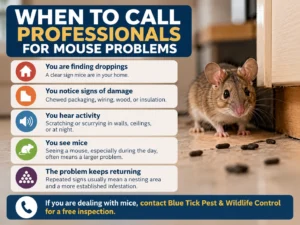
If you are finding droppings and want to know how serious the problem is, a professional inspection is the fastest way to confirm what you are dealing with and how the mice are getting in. Blue Tick Pest & Wildlife Control takes an inspection-first approach: identify the activity and entry points, remove the mice, seal the openings, and handle cleanup safely, which matters a great deal when deer mice and hantavirus are a possibility.
Blue Tick is licensed and insured, locally family owned and operated, with more than 40 years of combined experience serving Littleton, the Denver metro area, the Front Range, and nearby foothill and mountain communities. If you have found droppings in your home, contact us for a free inspection.