
A scratching or scurrying sound inside the wall, usually after dark, is one of the most unsettling ways to discover a pest problem. You cannot see what is making the noise, which makes it hard to know how worried to be. In most homes, those sounds in the walls come from mice.
Mice are small, light, and active at night, so they often move through wall cavities and ceilings long before anyone sees one in a room. The sounds they make, along with a few other signs, can tell you a great deal about what is happening behind the drywall and what to do about it.
This guide covers what mice in walls sound like, how to tell them from rats or squirrels, how they get into wall cavities, the damage they can cause, and the safest way to get them out and keep them from coming back.
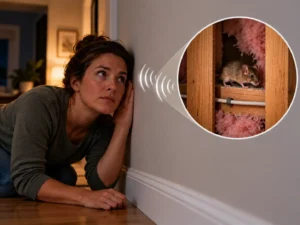
What Do Mice in Walls Sound Like?
Mice produce light, high-pitched sounds rather than heavy ones. The most common are quick scratching, faint scurrying or rustling, and soft, intermittent gnawing as they chew to keep their teeth worn down. The noise tends to be brief and on the move, a short burst that travels along a wall or ceiling and then stops. Because a mouse weighs so little, the sound is subtle and easiest to notice in a quiet room at night.
When Are Mice Most Active?
Mice are mostly nocturnal, with peak activity from dusk through the overnight hours. That is why scratching noises in the walls are most often noticed at night, when the house is quiet and the mice are awake and foraging. Steady noise during the middle of the day is a hint that something other than a mouse may be involved.
How Do Mice Get Inside Wall Cavities?
Mice do not chew their way in from your living room. They enter from outside and then travel through the hidden framework of the house. A mouse can squeeze through a gap about 1/4 inch wide, roughly the width of a pencil, and it uses the same entry points that let mice inside in fall: foundation cracks, gaps around pipes and utility lines, spaces under garage doors, worn door sweeps, and openings near vents and the roofline. The EPA recommends finding and sealing these rodent entry points as the foundation of long-term control.
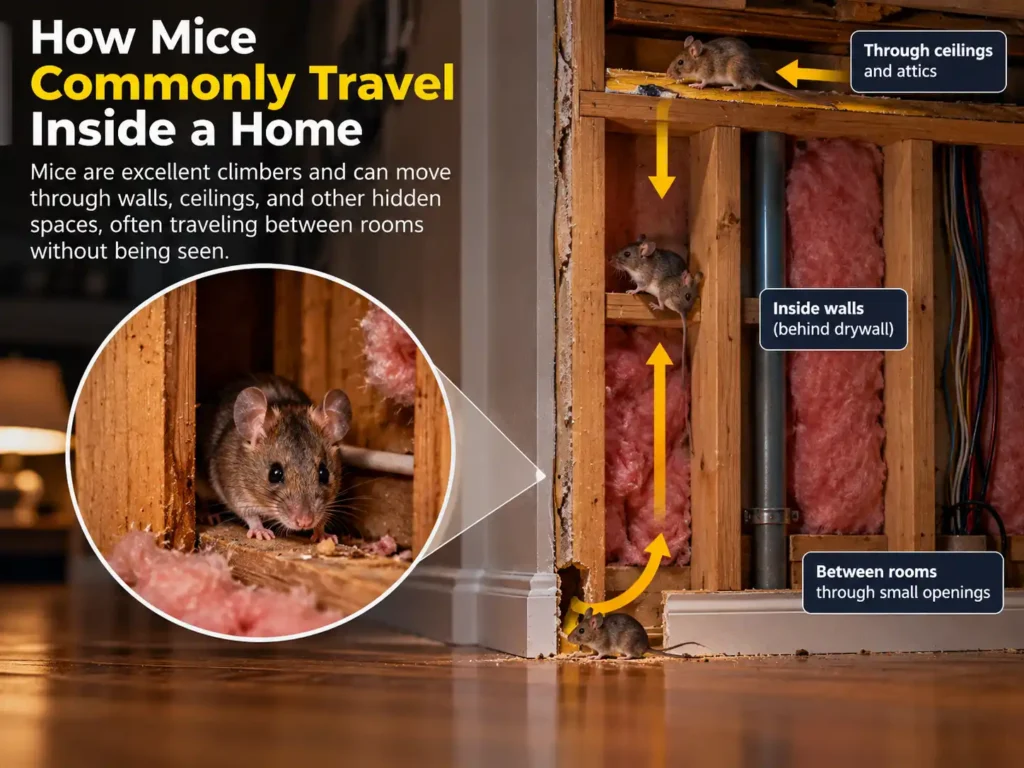
Where Mice Commonly Travel Inside a Home
Once inside, wall cavities act like hidden highways. The vertical spaces between studs, along plumbing stacks, and beside wiring runs let mice move between floors, into ceilings, and up to the attic without ever showing themselves. This is how a home can have mice in the walls and ceiling while no one sees a mouse in a living space.
How to Tell Mice From Rats, Squirrels, or Other Wildlife
Sound is a useful first clue, though it is not proof on its own. The size of the animal, the time of day, and the type of noise all help narrow it down.
Mouse Sounds
Light scratching, rustling, and soft gnawing, usually at night, often high in a wall or in the ceiling. The movements are quick and quiet.
Rat Sounds
Louder and heavier than mice, with more forceful gnawing and scratching, sometimes squeaks, and the sense of something larger moving. Rats are also mostly active after dark.
Squirrel and Larger Wildlife Sounds
Squirrels make heavier scampering and rolling sounds, often during the day, especially early morning and late afternoon, and usually in the attic. Distinct thumps, heavy movement, or vocalizations at night can point to raccoons or other larger wildlife. If the noise is loud, heavy, or clearly happening in daylight, it is worth ruling out something bigger before assuming mice.
Signs That Confirm Mice Are in the Walls
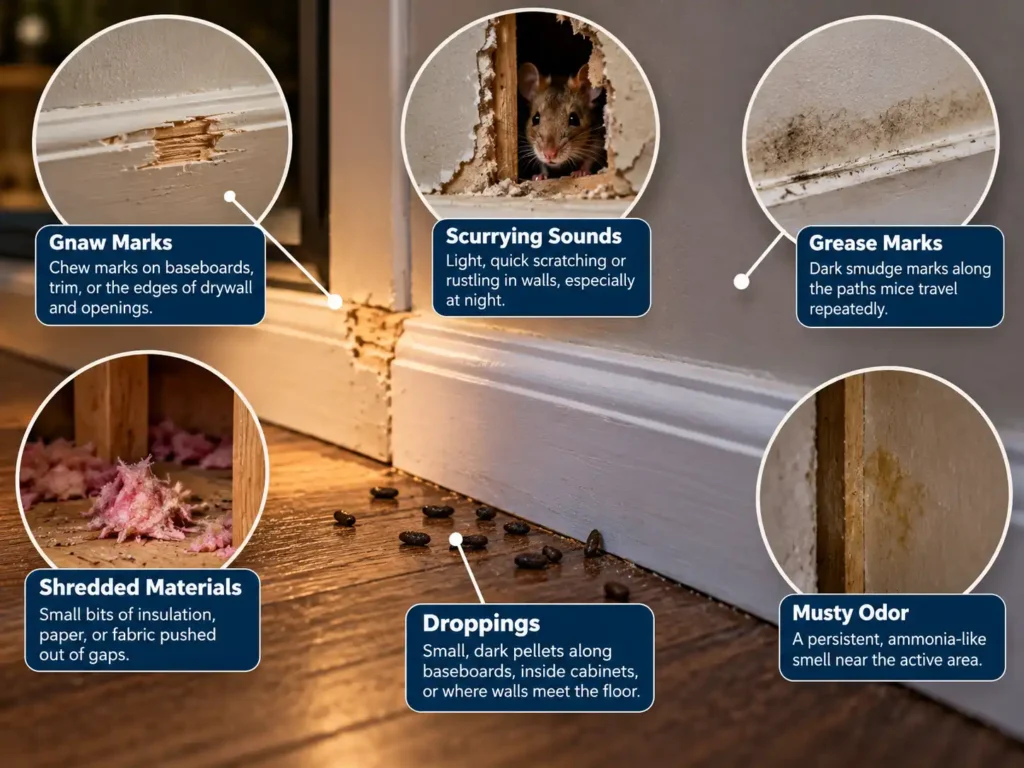
Sound points you in the right direction, and other signs confirm it:
- Small, dark droppings along baseboards, inside cabinets, or where walls meet the floor
- Gnaw marks on baseboards, trim, or the edges of drywall and openings
- Dark grease or smudge marks along the paths mice travel repeatedly
- A musty, ammonia-like odor near the active area
- Small bits of shredded insulation, paper, or fabric pushed out of gaps
For the full rundown of what to look for, see Blue Tick’s guide to the early signs of a mouse infestation. When several signs appear together, you are likely dealing with more than a single mouse.
Can Mice Damage Wiring, Insulation, or Drywall?
Yes, and this is why mice in walls are more than a nuisance. Mice gnaw constantly, and inside a wall that often means:
- Chewed electrical wiring, a recognized fire risk once the protective insulation around a wire is stripped away
- Shredded or matted insulation, which lowers its effectiveness and the comfort and efficiency of the home
- Gnawed drywall, baseboards, and trim, sometimes widening a small gap into a larger opening
- Contamination from urine and droppings left in the cavity and insulation
Mice cannot chew through concrete or metal, but they work through drywall, wood, and soft materials easily, and they will enlarge an existing gap to fit.
Will Mice Eventually Leave on Their Own?
Usually not. Once mice have found warmth, shelter, and food access, they have little reason to leave, and cold Colorado weather only makes an indoor nest more valuable. Mice also breed quickly, so waiting tends to let a small problem spread into other wall voids, the ceiling, and the attic.
What Not to Do When You Hear Mice in the Walls
Avoid a few common mistakes. Do not cut open the wall at the first sound, since you may not find anything and will create a mess and a new route into the room. Do not ignore it in the hope that it resolves itself. And do not sweep or vacuum any droppings you find while they are dry, which can send particles into the air.
Why Poison Can Create Problems Inside Walls
Rodenticide is especially risky for a wall problem. A poisoned mouse often dies where you cannot reach it, inside the cavity, which can mean days or weeks of strong odor, flies, and a cleanup that may require opening the wall. Poison also poses secondary risks to pets and wildlife, and it does nothing to seal the openings that let mice in.
Why Trapping Alone May Not Solve the Problem
Traps can remove the mice already active inside, but they do not close the gaps that allowed entry. Without sealing those openings, new mice follow the same routes. Trapping works best as one part of a plan that also includes inspection and exclusion.

How to Get Mice Out of Walls
Getting mice out of walls takes more than a single trap. It means finding the activity, removing the animals, and closing the entry points so the problem does not simply return.
Inspection and Identification
A professional starts by mapping the activity from droppings, sounds, grease marks, and travel paths, and by confirming that mice, rather than another animal, are responsible. That picture determines where to focus instead of guessing.
Removal and Monitoring
Traps are placed in the right spots based on the inspection, then monitored and adjusted until the activity stops. This targeted approach is more effective than scattering traps at random, and it avoids leaving dead mice in places you cannot reach.
Why Exclusion Matters After Removal
Removal without exclusion is only temporary. Exclusion means sealing the entry points with rodent-resistant materials so the next mouse cannot use the same route. Pairing removal with professional mice and rodent control that includes exclusion is what turns a recurring problem into a solved one.
What to Do If a Mouse Dies Inside a Wall
Sometimes a mouse dies inside a wall, often after eating poison placed elsewhere, and the result is a strong odor that can last from several days to a few weeks depending on size and temperature. There is rarely a way to speed it up without locating the source, which sometimes means opening a small section of drywall. When droppings or nesting material are involved, follow safe cleanup practices rather than sweeping or vacuuming, in line with the CDC’s guidance on cleaning up after rodents. For a strong odor or heavy contamination, Blue Tick’s sanitation and cleanup services can locate the source and remediate the area.
Frequently Asked Questions About Mice in Walls
Can mice chew through drywall?
Yes. Drywall is soft enough for mice to gnaw through, and they will enlarge an existing gap or hole to reach a room when they are motivated by food. They cannot chew through concrete or metal, which is why those materials are used to seal entry points.
How long can mice live inside walls?
An individual mouse usually lives about a year, but that is not the real issue. As long as a wall offers shelter with food and water nearby, mice will keep nesting and breeding there, so activity can continue indefinitely until the entry points are sealed and the mice are removed.
Can mice get into rooms from wall cavities?
They can. Wall cavities connect to floors, ceilings, and attics, so mice traveling through the walls can reach cabinets, pantries, and living areas in search of food. That is one more reason to deal with wall activity early rather than wait.
Are scratching noises always caused by mice?
Not always. Mice are the most common source of light scratching at night, but rats, squirrels, birds, and larger wildlife can all make noise inside walls and ceilings. Heavy, loud, or daytime sounds in particular are worth having checked, since the right response depends on the animal.
How do professionals get mice out of walls?
A professional inspects to confirm the animal and locate the activity, places and monitors traps in the right spots, removes the mice, and then seals the entry points so new ones cannot follow. Cleanup of droppings and nesting material is handled safely as part of the process.
When to Call Blue Tick Pest & Wildlife Control
If the scratching is keeping you up at night, or you have confirmed mice with droppings and gnaw marks, a professional inspection is the fastest way to learn the scope of the problem and how the mice are getting in. Blue Tick Pest & Wildlife Control uses an inspection-first process: locate the activity and entry points, remove the mice, seal the vulnerable openings, and handle cleanup where needed.
Blue Tick is licensed and insured, locally family owned and operated, with more than 40 years of combined experience serving Littleton, the Denver metro area, the Front Range, and nearby foothill and mountain communities. If you are hearing mice in your walls, contact us for a free inspection.